
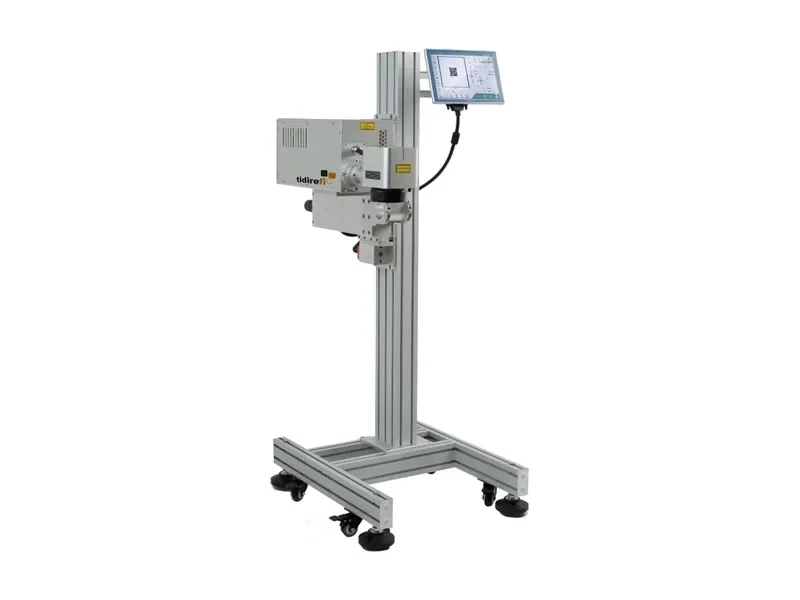
20–100 W
Fibre 1064 nm
Laser printers
Permanent marking with no ink or consumables: fibre, CO2 and UV lasers for metal, plastic, glass, cardboard and more.
29
models
6
technologies
4 printers
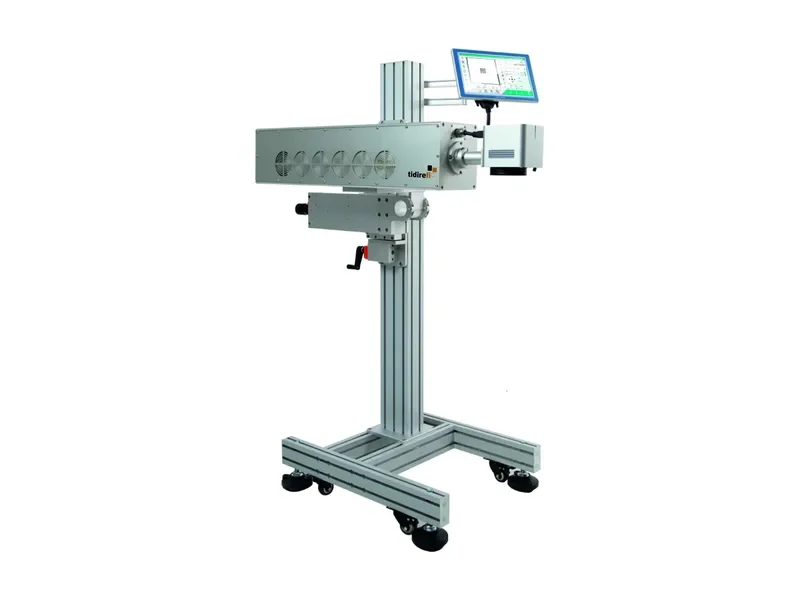
30 W / 60 W
CO2
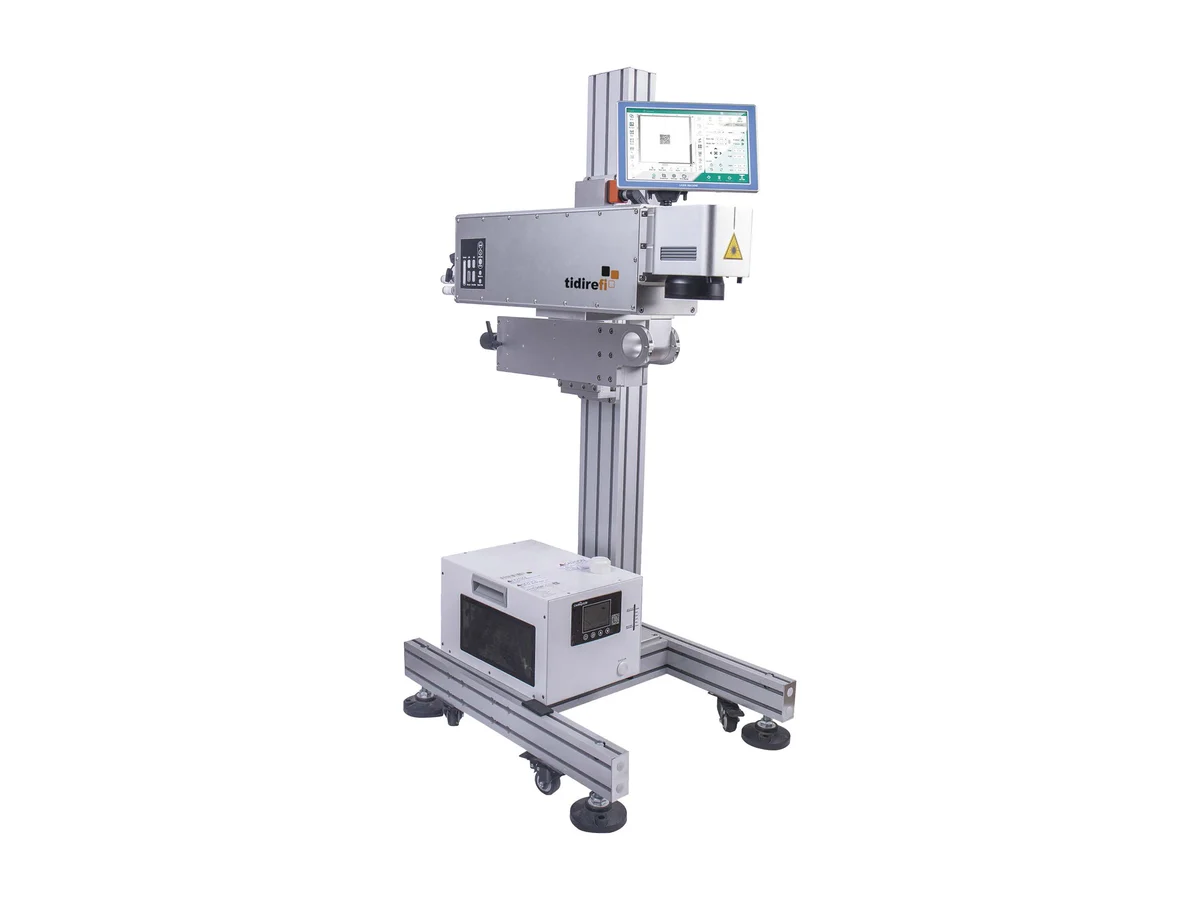
3 W / 5 W
UV 355 nm
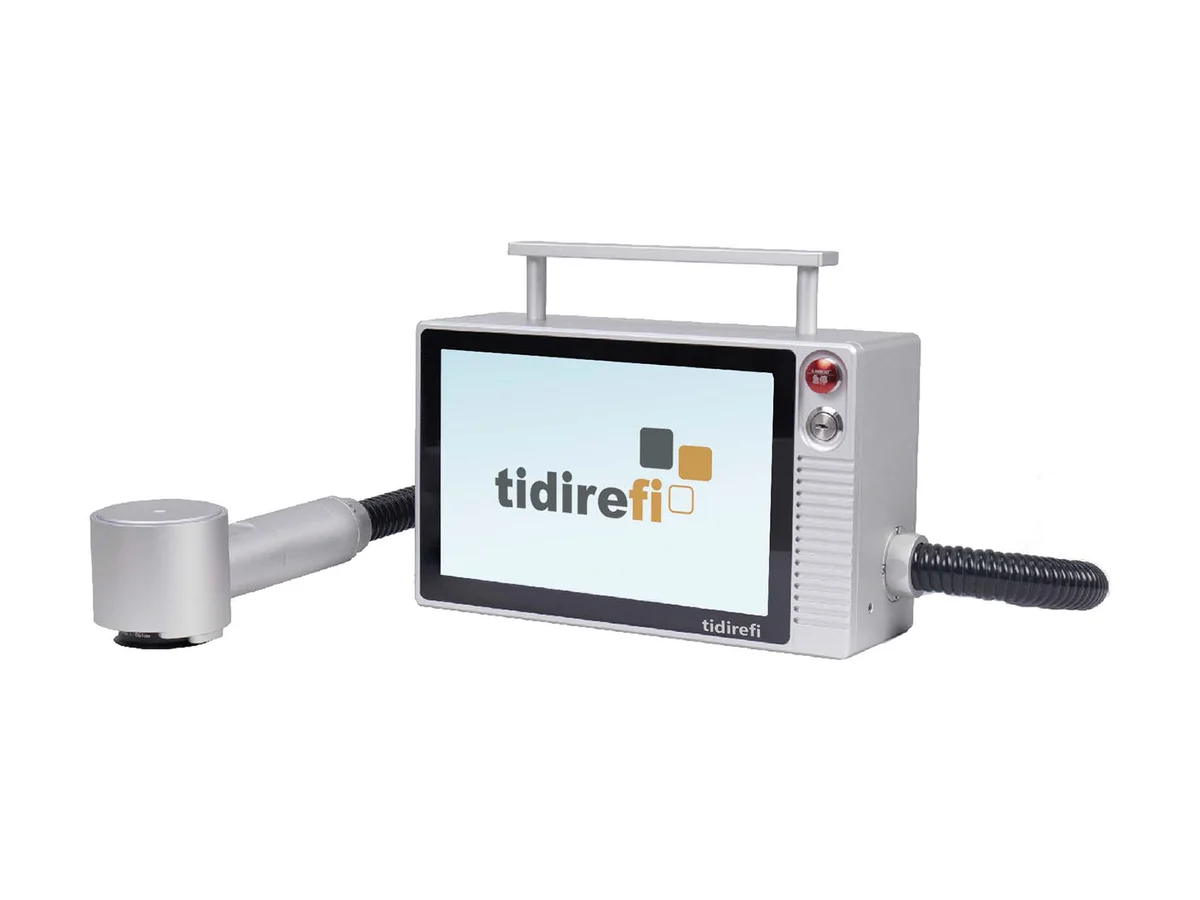
18 W / 23 W
Portable
Which technology do I need?
It depends on the surface, the line speed and the code size.
Which laser for which material
Guide table to choose the equipment and a starting point for its settings. Power is given as % of the nominal power of the listed unit; speed in mm/s of beam travel; hatch is the spacing between fill lines. Because % power is not comparable between units, some rows give it per model.
| Material | Recommended laser | Marking result | Starting settings (guide) |
|---|---|---|---|
| Stainless steel: engraving | Fibre KLFN 20-100 W · portable KLFP | Permanent grey/light engraving | KLFN20: 55-70 % · 800-1,200 mm/s · 35 kHz · cross-hatch 0.05 mm KLFN30: 35-45 % KLFN50: 20-30 % KLFN100: 10-15 % (same average power, ~11-14 W) deep: 80-100 % · 300-500 mm/s · 30 kHz · several passes |
| Stainless steel: black mark | Fibre KLFN 50-100 W (depending on source) | Dark mark with no relief (annealing); depends on the laser source | KLFN50: 8-12 % · 150-250 mm/s · 80-100 kHz · hatch 0.02 mm · 5-10 passes, slight defocus a clean, repeatable black needs a MOPA laser; sample test required and passivation for food or medical use |
| Anodised aluminium | Fibre KLFN 20-50 W · UV KLUVN | Light mark by removing the anodic layer | Fibre 20 W: 25-45 % · 600-1,000 mm/s · 40-60 kHz · hatch 0.03 mm · 1-2 passes UV: 40-80 kHz · 500-1,000 mm/s · 1 pass |
| Bare aluminium, brass and copper | Fibre KLFN 30-100 W · UV KLUVN (copper) | Grey or bright engraving | 70-100 % on 30 W, 40-70 % on 100 W · 100-500 mm/s · 20-45 kHz depending on source · hatch 0.02-0.05 mm · several passes copper is highly reflective: test |
| Painted or coated metal | Fibre KLFN · UV KLUVN | Paint removal, exposing the metal | Fibre 20 W: 55-70 % · ~1,000 mm/s · 35 kHz · hatch 0.04 mm UV: 40-70 % · 400-800 mm/s · 30-60 kHz CO2 only removes paints that absorb 10.6 µm: to be validated |
| Engineering plastics (ABS, PC, PA) | Fibre KLFN · UV KLUVN | Colour change with no relief; contrast depends on the pigment | Fibre 20 W: 60-90 % · 1,200-2,000 mm/s · 30-45 kHz · hatch 0.03-0.05 mm UV: 300-1,500 mm/s · 30-60 kHz · 1-2 passes |
| PET and PET film | CO2 KLCN (optional 9.3 µm) · UV KLUVN | White (foamed) or fine mark; thin film may be pierced at 10.6 µm | CO2: low power, 10-30 % · 2,000-4,000 mm/s, increase gradually UV: 30-70 % · 800-2,000 mm/s · 30-60 kHz |
| PE and PP (containers, caps, film) | UV KLUVN · fibre with additive in the plastic | Contrast depends on pigment or additive; no guarantee on natural material | UV: 30-70 % · 800-2,000 mm/s · 30-60 kHz · hatch 0.03 mm CO2 gives little contrast on PE and PP: sample test |
| PVC or silicone cables and tubes | UV KLUVN · CO2 KLCN with extraction | Sharp text without damaging the jacket | UV: 30-60 % · 1,000-2,000 mm/s · 30-60 kHz · hatch 0.03 mm PVC releases HCl: extraction and filtration are mandatory |
| Glass | CO2 KLCN · UV KLUVN | Fine frosting | UV: 200-400 mm/s · 30-50 kHz · hatch 0.05 mm · 1-2 passes CO2: 20-40 % · 500-1,500 mm/s, watch for micro-cracks on thin glass |
| Cardboard, paper and labels | CO2 KLCN · UV KLUVN | Browning or removal of the printed layer | CO2: 10-30 % · 1,000-3,000 mm/s · hatch 0.1 mm UV: 20-50 % · 1,000-2,500 mm/s |
| Wood, cork and leather | CO2 KLCN | Browned engraving | 12-30 % (KLCN30) · 400-900 mm/s · hatch 0.05-0.1 mm |
| Ceramics and rubber | CO2 KLCN | Light or dark mark depending on the finish | CO2: 20-40 % · 500-1,500 mm/s · sample test required |
| Circuit boards (PCB) | Fibre KLFN 20 W · UV KLUVN | Light mark on solder mask | Fibre: ~95 % · ~1,000 mm/s · 30-32 kHz · hatch 0.01 mm UV: on request |
Starting values for guidance only: final settings depend on the model and power chosen, the lens (marking area), number of passes, the actual material finish and line speed. Before installation we run a test on samples of your product and give you the validated settings.
Which ink do you need?
Tell us your printer and the surface you mark. We will recommend the right ink and send you a quote.
1
Tell us your printer, the surface and the colour you need.
2
Our technical team recommends the right ink.
3
You receive a quote with the recommended ink for your line.
Request sent
We have sent you a confirmation email. Our technical team will review your printer and surface and get back to you with the recommended ink.